Why Your Sales Team Knows the Disease but Not the Patient
What immersive VR can teach pharma teams that a slide deck never will.
The empathy gap
Every pharma field team I know is well trained on the science. They can explain mechanism of action, walk through trial data and answer detailed clinical questions. And yet, when a physician asks "what does this actually mean for my patient's day?", the conversation often goes quiet.
Knowing a disease and understanding a patient are two different things. Most training programs are built for the first. Very few address the second.
Conditions that affect movement, cognition or daily independence are especially hard to grasp from a distance. You can read that a patient struggles with eating, dressing or holding a cup. You can watch a video. But reading and watching are passive. You stay on the outside of the experience.
This matters commercially and ethically. Healthcare professionals notice when a representative understands the lived reality of a condition, and when they only repeat the label. Conversations become more relevant, more respectful and more useful to the physician and, ultimately, to the patient.
What VR changes
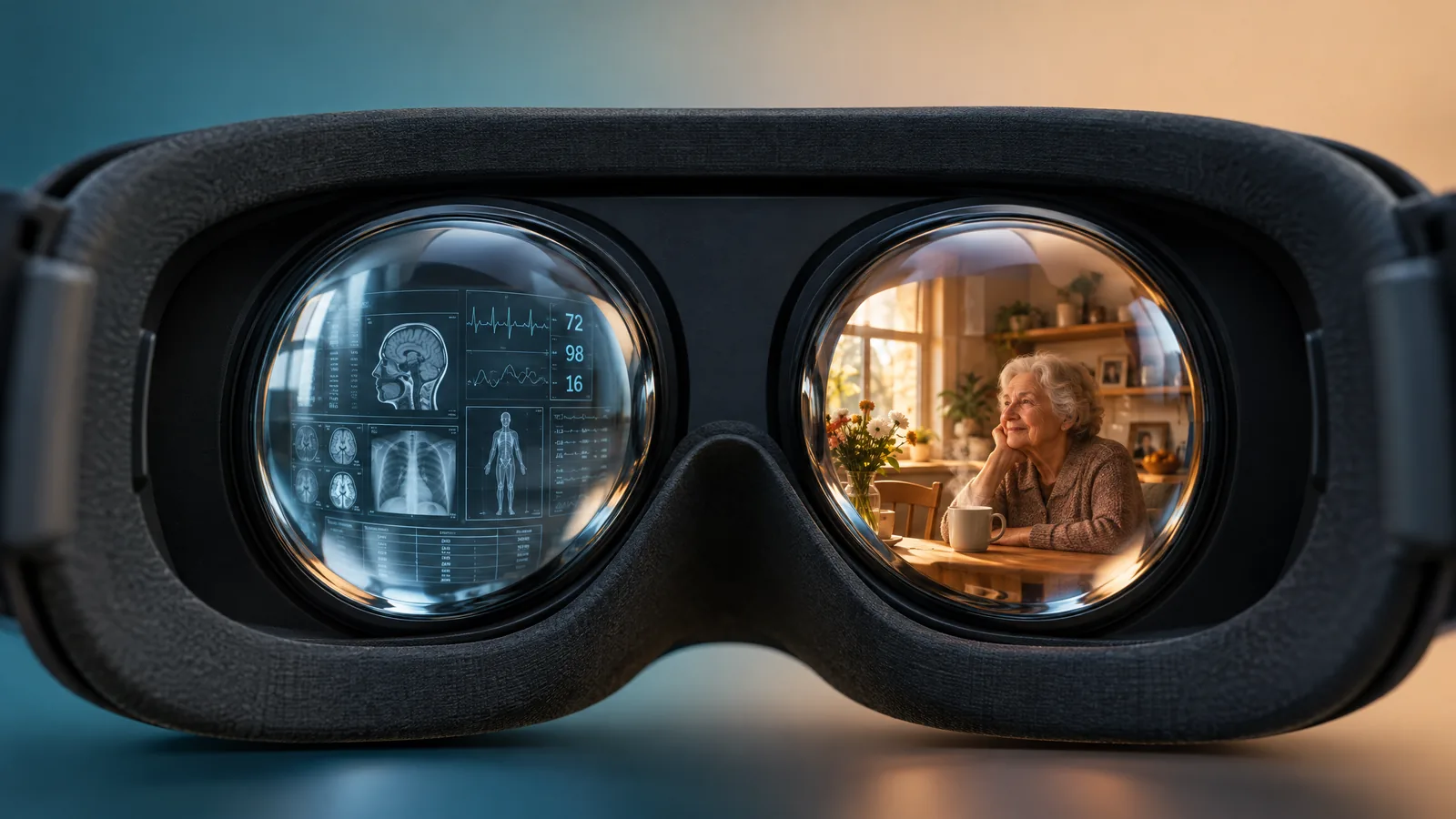
Virtual reality does not describe a symptom; it lets someone experience a simulated version of it. In a headset, a learner can attempt everyday tasks (making coffee, getting dressed, eating a meal) while the simulation introduces the kinds of movement difficulties a patient might face.
In a recently published program for a biopharma team preparing for a new-indication launch, the effect was immediate. Participants did not come out of the headset with new facts. They came out with a different perspective, and many described the experience as emotionally striking. That shift is hard to create with any other format.
Four design principles that make it work
- Show progression, not a single snapshot. A condition looks different at an early stage than at an advanced one. Building scenarios that move through stages helps learners understand how the disease changes daily life over time, not just how it looks at one moment.
- Combine the physical and the emotional. Difficulty with movement is only half the story. Frustration, embarrassment and loss of independence are part of the experience, and a good simulation makes room for them.
- Keep sessions short and focused. Immersive experiences are intense. Sessions measured in minutes, not hours, keep attention high and leave time for what matters most: the conversation afterwards.
- Always debrief. The headset is only the start. The learning sticks when the team reflects together, connects the experience to real customer conversations and agrees on what they will do differently.
What it is not
A VR simulation is not a replacement for clinical training, and it is not a promotional tool. It should be developed with medical input, reviewed within your compliance framework, and positioned as education that helps teams communicate with greater understanding. The goal is better, more patient-centred conversations, not louder messaging.
How to start
You do not need a large program to test the idea. A practical path looks like this:
- Choose one condition where the patient experience is hard to explain in words.
- Define what you want learners to understand, not just what you want them to know.
- Build a short prototype with a clear learning objective and a facilitated debrief.
- Measure what changes in learner confidence, empathy and the quality of customer conversations.
Thinking about experiential training for your team?
At Kucharski Consulting, we design and build VR and AI simulations for pharma and medtech teams, white-label, so the experience carries your brand and your medical narrative. You bring the therapeutic expertise and regulatory guardrails; we bring the engineering. If you are thinking about experiential training for your field, medical or patient-facing teams, we would be glad to share a short demo.
The program mentioned above is described in LTEN Focus, June 2024. This article is also published on LinkedIn.